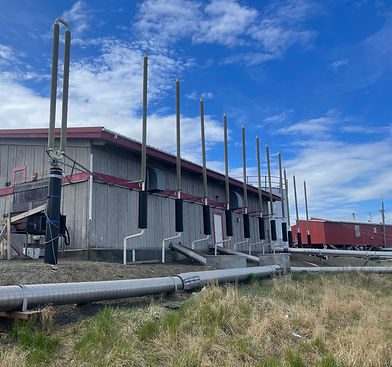
Two-phase thermosyphons are passive refrigeration devices that transfer heat against gravity. Construction is typically a closed-ended tubular vessel charged with a two-phase working fluid. The vapor phase of the working fluid fills the majority of the interior of the vessel, with the liquid phase filling the minority of the volume.
Thermosyphons function because of the two-phase working fluid. The working fluid is contained in a closed, sealed vessel (Thermopile or Thermoprobe) that is partially buried. Thermosyphons have typically functioned passively in cold climates during the winter months, at which time the above-ground portion is subjected to cold ambient air which cools and condenses the working fluid. The condensed... read more
Thermopiles are load bearing two-phase thermosyphons that are generally used to found structures where permafrost soils exist. Typical thermopile applications follow:
-
Installation at sites with a frost-susceptible active layer where heave and pile jacking are problems. Thermo-cycling reduces frost heave forces to negligible quantities.
-
Installation in marginal permafrost where pile creep rates are high. Thermo-cycling reduces soil... read more


Thermo Helix-Piles are Thermopiles with helical shear rings attached and can be used in all applications where Thermopiles are appropriate. At one time, individual rings were used instead of the helix. Most applications use a helix that has a strip width of 2 inches (50mm). Typical Thermo Helix-Pile applications follow:
-
Generally, Thermo Helix-Piles support greater loads than adfreeze piles. Shear loading in lieu of adfreeze allows higher unit stresses that equate to shorter embedment depths... read more


Sloping Evaporator Thermoprobes are found on the majority of existing passive subgrade cooling system installations beneath slab-on-grade structures. These units utilize a sloped evaporator to insure that the condensate will flow from the condenser to the lowest portion of the evaporator.
Typically, evaporator slopes are between 10% and 3% - with the median being 5%
Structures founded on grade over permafrost utilizing Thermoprobes for subgrade cooling also have two other very important components of design: subgrade insulation and NFS fill. the typical thermal design methodology for... read more
Thermoprobes with flat-loop evaporators utilize proprietary internal components within the riser to force the working fluid to travel in one direction within the evaporator. As the working fluid absorbs heat, it vaporizes and expands.
The expansion helps to push the working fluid around the loop. The working fluid moves around the loop in two-phase flow, increasing in velocity as it proceeds around the loop.
This allows the loop to be placed on a 'relatively' flat plane. The term 'relatively' means that there can be some undulations in the vertical profile of the loop. Typical designs allow for as much as six inches (150mm) amplitude in the... read more


Thermoprobes with buried condensers are designed to release the heat picked up from the subgrade through the near surface soils or embankment. A typical application for these units is in roadway or airfield sections where heat is released just under the pavement.
The condensers can be coupled to either vertical or sloping evaporators. The system is designed to provide a net cooling below the embankment section to preserve the permafrost. Because the condensers release heat through the surface, insulation can be used in the design without the icing effects that are typical of insulated sections.
In cold climates, this system is generally not... read more
Hybrid thermosyphons are designed so that they can be cooled actively as well as passively. Active cooling means that some external energy must be expended to promote cooling - mechanical refrigeration is typically used.
Most any of the thermosyphons manufactured by AFI can be built as hybrid units with the addition of an internal heat exchanger.
A hybrid unit does not have to be actively cooled. The hybrid portion of the design might be to provide a higher redundancy factor over the life of the project. A typical application for hybrid thermosyphons is to accelerate... read more